Cleaning Recipes
DIY Cleaning Products for ADHD Brains (The Three Recipes You'll Actually Use)
Every DIY cleaning article gives you 25 recipes with 15 ingredients. You will use zero of them. The reason is not that the recipes are bad. The reason is that ADHD brains cannot manage a 25-recipe system. By Tuesday you forget which bottle is which. By Friday they are all empty or growing things.
This article gives you three recipes. Total ingredient list: five things. All five are at every grocery store. Bottle labels not required because you only have three bottles. Total reading time: less than the time you would spend choosing between 25 recipes.
Why most DIY cleaning guides fail ADHD brains
Standard cleaning advice fails ADHD brains for very specific reasons. The biggest reason is volume. Most guides give you too many recipes. This creates immediate decision fatigue. When you have to choose between a wood cleaner, a glass cleaner, a tile cleaner, and a stainless steel cleaner, your brain shuts down. You end up cleaning nothing at all.
They also require too many ingredients. This adds a massive executive function load. You have to buy washing soda, borax, essential oils, castile soap, and citric acid. You have to remember where you put them in your crowded cabinets. You have to remember which ingredient goes into which specific recipe. This is exhausting before you even pick up a sponge.
Then there is the bottle problem. They tell you to use identical bottles for every recipe. This triggers object permanence issues instantly. You completely forget which bottle holds which liquid. You forget if the blue liquid is the glass cleaner or the floor cleaner.
Finally, they give you too many restrictive rules. You are told to use one spray on the mirror and a completely different spray on the sink directly below the mirror. That increases your cognitive load to an impossible level.
The fix is not better organization. The fix is radical reduction. Most guides tell you to make a custom cleaner for every single surface in your house. We are going to make three that cover everything. It is a system built to bend instead of break. You do not need a separate stainless steel polish. You need fewer bottles.
The five ingredients (and what they each do)
You only need five things to clean your entire house. These are the same ingredients every top cleaning guide recommends. We just stopped at five and went home.
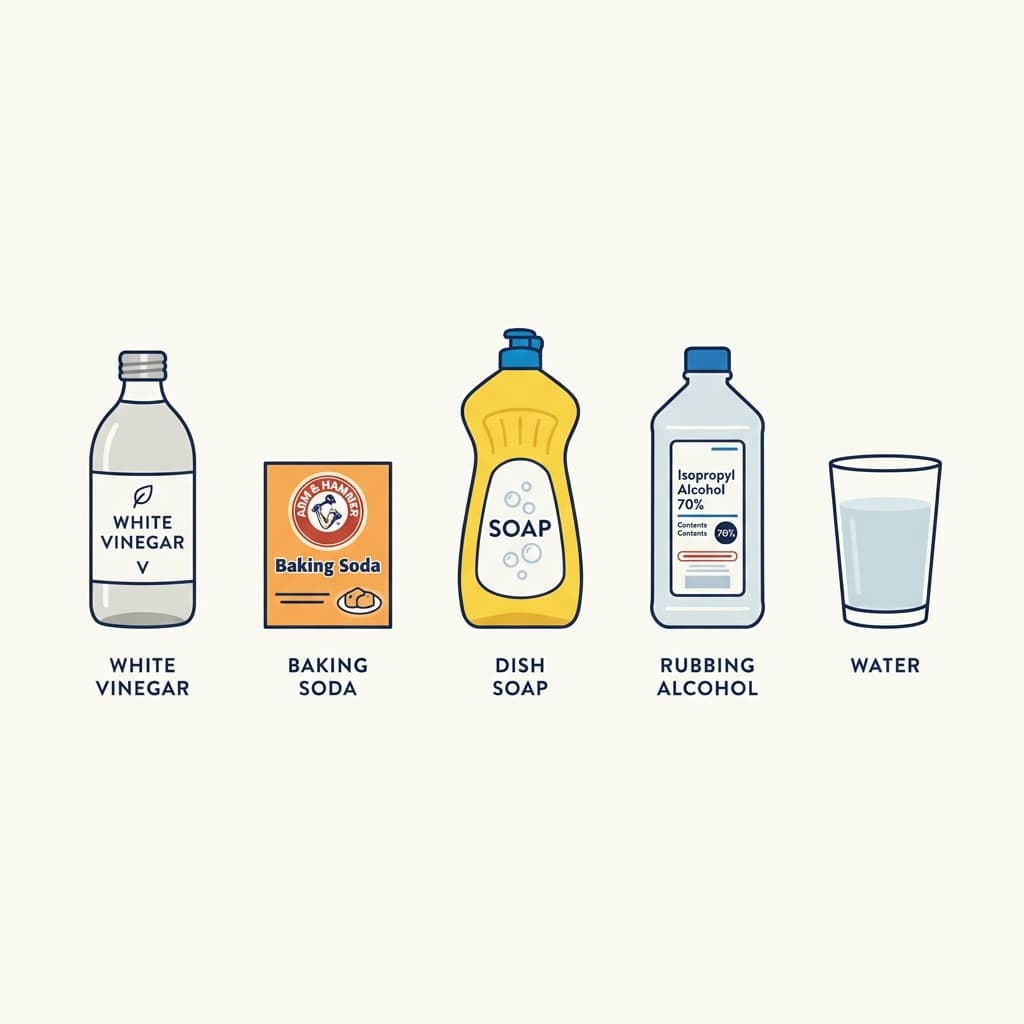
White vinegar
White vinegar is an acid. It cuts through grease easily. It removes hard water stains from your shower. It deodorizes bad smells in your kitchen. It is the absolute powerhouse of DIY cleaning.
Baking soda
Baking soda is a base. It acts as a gentle abrasive. It provides heavy scrubbing power without scratching your delicate surfaces. It lifts stuck-on food and neutralizes lingering odors.
Dish soap
Dish soap is a surfactant. It lifts dirt away from surfaces. It breaks down heavy oils and fats. It is incredibly cheap, highly concentrated, and safe for almost every material in your home.
Rubbing alcohol (70%+)
Rubbing alcohol is a solvent. It disinfects surfaces quickly. It evaporates almost instantly into the air. This means it leaves zero streaks on shiny surfaces like mirrors and fixtures.
Water
Water is the carrier. It dilutes the active ingredients. This prevents them from damaging your surfaces. It spreads the cleaning power evenly across a larger area.
Recipe #1 — All-purpose spray (the one bottle that does 80% of cleaning)
This is the only daily spray you need. It handles almost every surface in your house. It cuts grease, lifts dirt, and wipes away cleanly without leaving a heavy residue.
The recipe: 1 cup water, 1 cup white vinegar, 1 teaspoon dish soap.
Pour it all into a spray bottle. Shake it gently. Done.
What it cleans: Use this on counters, sinks, tile floors, appliances, bathrooms, and glass. Yes, glass. The standard DIY advice says do not use soap on glass because it streaks. The standard advice is wrong for ADHD brains who will simply not make a second bottle just to clean a mirror. Just wipe the glass completely dry with a microfiber cloth. The streaks will disappear entirely.
What it doesn't clean: Natural stone. Vinegar is an acid. It will etch granite, marble, and quartz over time. If you have stone counters, make one swap. Use rubbing alcohol instead of vinegar in this recipe. It works just as well and protects your expensive stone finishes.
Recipe #2 — Scrub paste (for the stuck-on stuff)
Sometimes a spray is not enough. You need friction. This paste provides the mechanical scrubbing power required to lift burnt food and deep stains that a spray cannot handle.
The recipe: Baking soda and water. Mix it in a small bowl until it reaches the consistency of toothpaste.
That is the whole recipe.
What it cleans: Use this on dirty stove tops, the inside of the oven, filthy bathroom grout, stubborn tub stains, and heavily burnt pots and pans.
The trick: Do not make this in advance. Make it exactly when you need it. ADHD brains will lose any pre-mixed paste in a jar within 48 hours. It will dry out and turn into a brick under your sink. When you encounter the loudest mess, pour a little baking soda in a bowl, add a splash of water, and mix a fresh batch. It takes ten seconds.
Recipe #3 — Disinfecting spray (for the gross stuff)
Cleaning removes dirt. Disinfecting kills germs. These are two completely different jobs. You need a dedicated spray for the germs that make you sick.
The recipe: 2 parts rubbing alcohol (70% or higher) to 1 part water.
Pour it into a spray bottle. Shake it. Done.
What it kills: This kills the vast majority of household germs instantly.
What it cleans: Spray this on doorknobs, light switches, your phone, toilet handles, and absolutely anywhere you frequently touch with your hands.
Why not vinegar: People love to claim vinegar kills everything. It does not. Vinegar is very good at cleaning dirt, but it is mediocre at killing dangerous germs. You need the alcohol to break down the cellular walls of bacteria. Keep the jobs separate.
How to not lose track of which bottle is which
Here is the classic ADHD trap. You buy a highly aesthetic three-pack of identical amber glass spray bottles. You fill them with three different clear liquids. By Wednesday, you have completely forgotten which is which. You spray the disinfecting alcohol on a dirty window, and it smears into a cloudy mess. This happens due to ADHD object permanence—if they look identical, your brain stops tracking the contents.
The fix is simple. Do not use identical bottles.
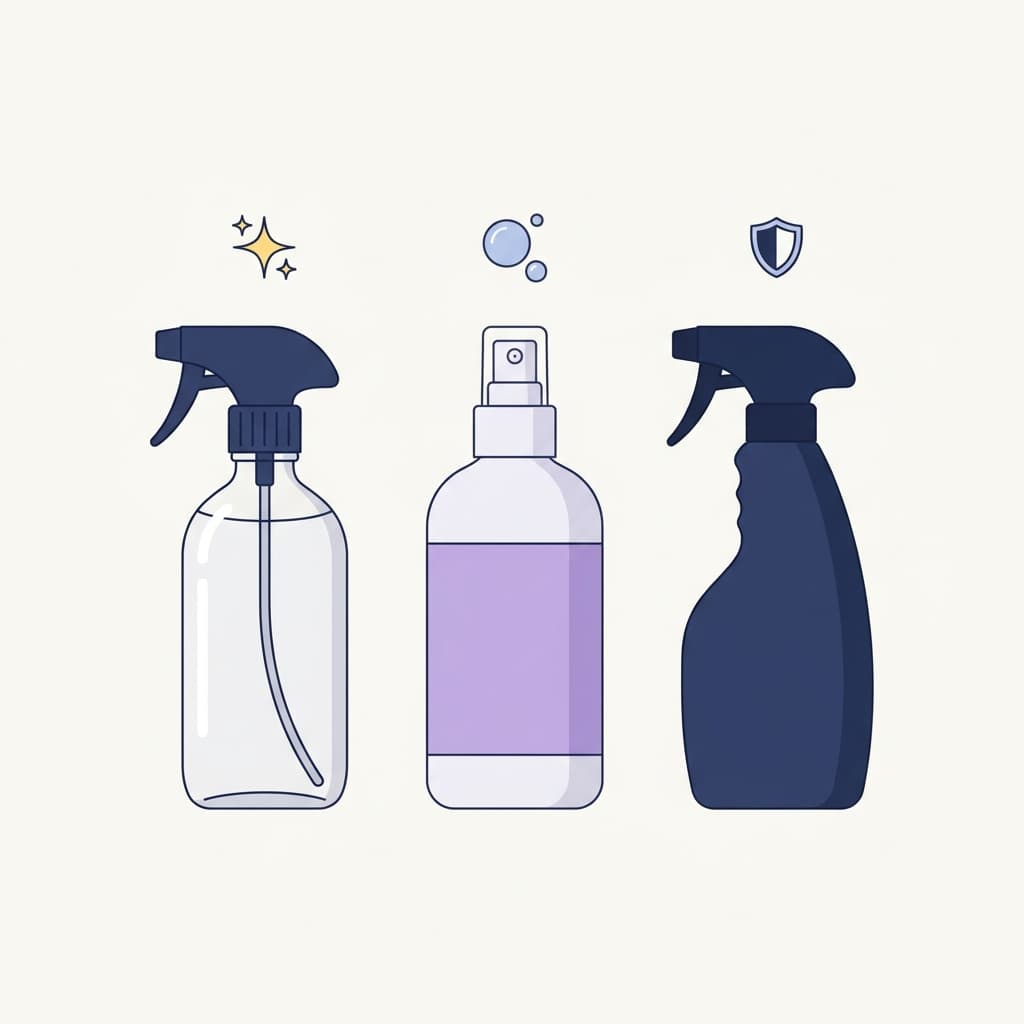
Use three obviously different bottles. Buy one clear bottle, one white bottle, and one blue bottle. The visual difference does the labeling work for you. You never have to read a label. You just grab the blue one when you need to clean the counters.
If you absolutely must use identical bottles, write on them directly with a thick permanent marker. Write the name in giant letters across the side. Do not use cute, printed paper labels. Labels fall off. They get wet. They peel at the corners. The marker stays forever.
What to skip from every other DIY cleaning guide
The secret to this system is what you choose to ignore. Every removed recipe is a removed decision. Skip these common recipes completely.
- Don't make laundry detergent. The math does not work. Homemade detergent is usually just a mix of soaps that leaves a residue on your clothes over time. Store-bought is cheaper, lasts longer, and actually cleans your fabrics. You will ruin your washing machine trying to save three dollars a month.
- Don't make glass cleaner separately. Recipe #1 does it just fine. You do not need a dedicated blue liquid taking up space in your cabinet.
- Don't make wood floor cleaner separately. Recipe #1 works perfectly for floors. Just add a little extra water to the mop bucket to dilute it further before mopping.
- Don't make a "fresh scent" version. If essential oils are a special interest for you, ignore this. Go wild. For everyone else, skip them. They cost extra, do nothing for cleaning, and the scent fades within an hour.
- Don't make a "natural air freshener" spray. Open a window.
When DIY cleaners aren't worth it
DIY cleaning solutions do not beat commercial products for everything. You need to know when to buy the hard stuff so you do not waste your time scrubbing endlessly.
Do not try to make homemade bleach products. Do not make DIY oven cleaner for serious, baked-on grease fires. Buy commercial drain cleaner when your sink backs up. Buy commercial toilet bowl cleaner for thick, stubborn hard water rings. Buy chemical mold remover for your shower corners.
Save your DIY energy for the daily stuff. ADHD brains do not need to optimize every single cleaning product into a homemade version. That is a productivity trap dressed up as frugality.
DIY cleaning recipes everyone makes that don't actually work
If you spend five minutes on TikTok or Pinterest, you will find hundreds of viral cleaning hacks. The pressure to copy them is real. They look highly satisfying on video. They promise to change your life and fix your house overnight. Do not fall for them. Most of these hacks are built for views, not for actual cleaning.
Here are the four most common viral DIY recipes that ADHD brains should ignore completely.
Toilet bowl bombs
These are little homemade cleaning tablets. You mix baking soda, citric acid, vinegar, and essential oils in a bowl, then press them into a tiny silicone mold to dry. You drop them in the toilet, and they fizz aggressively for a few seconds. The fizzing looks incredibly productive. It looks like it is doing heavy cleaning.
It is not. It is just a basic acid-base chemical reaction releasing harmless carbon dioxide gas into the air. The fizz has absolutely zero mechanical scrubbing power. It will not remove a hard water ring. It will not clean the hidden under-rim of your toilet bowl. It simply wastes good ingredients you could have used for Recipe #1.
What to do instead: Spray the bowl with Recipe #1. Scrub it manually with a stiff toilet brush. It takes forty-five seconds and actually works to remove the grime.
Laundry stripping
TikTok loves a giant blue bathtub full of dark, murky water. The video inevitably tells you this murky water is years of hidden, disgusting grime coming out of your supposedly clean sheets and towels. The recipe usually involves soaking your linens for six hours in a heavy, highly concentrated mix of borax, washing soda, and detergent.
The murky water is mostly a cosmetic illusion. You are aggressively stripping the dye out of your fabrics. You are breaking down the internal fibers of the cotton. If you do this regularly, your clothes and sheets will literally fall apart in the dryer. Furthermore, ADHD brains do not have the executive function to remember to drain a bathtub six hours after filling it. It will sit there for three days.
What to do instead: Wash your sheets weekly with regular store-bought detergent. Skip the bathtub entirely.
DIY dishwasher detergent
There are hundreds of viral recipes for homemade dishwasher pods floating around the internet. They usually involve mixing baking soda, salt, and citric acid into an ice cube tray and freezing them overnight. The math simply does not work. They do not save you any significant amount of money. More importantly, they do not clean your dishes nearly as well.
Modern dishwashers are incredibly complex machines. They are specifically designed to work with the synthetic surfactants and specialized enzymes found in commercial store brands. Baking soda and citric acid cannot compete with modern chemistry. Over time, these DIY pods will leave a chalky film on your glasses and eventually clog your machine's spray arms.
What to do instead: Buy the cheapest store-brand commercial dishwasher pods you can find. Toss one in the machine. Let the dishwasher do the hard work. Save your DIY energy for wiping down the counters.
Castile soap mixed with vinegar
This is the single most common DIY cleaning mistake on the entire internet. Castile soap is a base. Vinegar is a strong acid. If you mix them together in a spray bottle, they immediately cancel each other out chemically.
You do not create a powerful super-cleaner. You create a cloudy, curdled, completely useless mess. It actually unsaponifies the soap. It leaves a weird, oily film on all your surfaces that is significantly harder to clean up than the original mess you were trying to wipe away.
What to do instead: Pick one. Use dish soap for your all-purpose spray, or use vinegar. Do not mix castile soap and vinegar in the same bottle under any circumstances.
How to actually use these (the system)
Recipes alone do not fix anything. A list of ingredients on the internet will not clean your kitchen. You need a reliable system that uses them without relying on your memory.
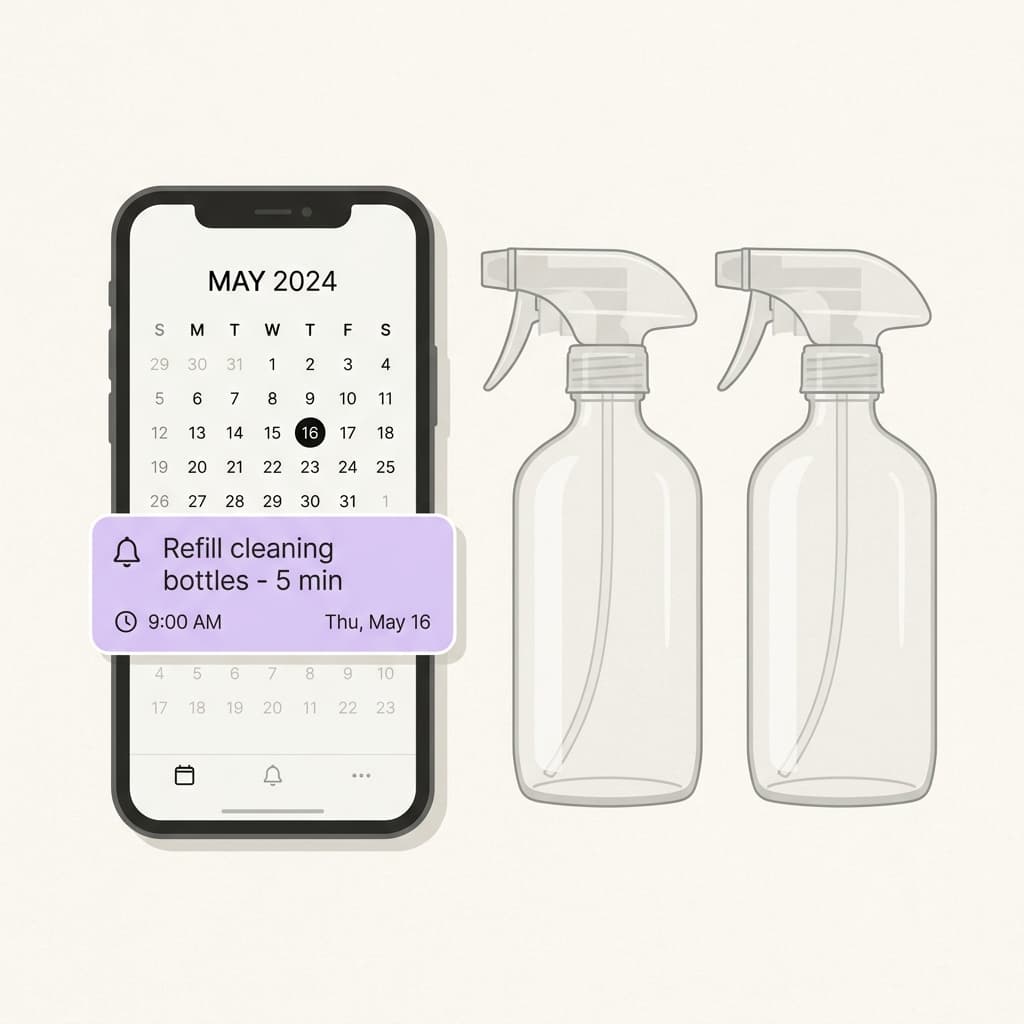
Pick one day a month to refill your bottles. Set a recurring phone reminder for that specific day. When a bottle runs empty on a Tuesday, do not try to remember to refill it later. "I'll refill it later" inevitably turns into "the bottle has been empty for three weeks."
Wait for your designated refill day and do them all at once. Our planneris built for exactly this kind of monthly maintenance task. Add "refill cleaning bottles" to your monthly reset and stop trying to remember it on your own.
Keep going
Pick your space, pick your energy, save your progress across seven days. No card required.
Common questions
The phone friendly planner is ready when you are.
Pick a room, check off tiny steps, save your progress. Free to try, one time payment to unlock everything.